- 2000Radio Tampa Hai2 / 1
- 2001Satsuki Sho3 / 1
Beat him twice and was never beaten by him, then broke down before the Derby and never raced again. The one score that could never be settled.
The Strongest(Pokke)
Follow my lead. I’ll show ya who’s the ‘strongest’!Jungle Pocket · ジャングルポケット
Full of mischief and a mouth that likes to boast, Jungle Pocket, “Pokke” to anyone brave enough, has exactly one ambition: to be the strongest runner who ever lived. Not the prettiest. Not the most graceful. The strongest.
She didn’t come up through the academy system. She came up on the street, running freestyle races at the head of a pack of ruffians who’d follow her anywhere. Then she watched Fuji Kiseki run, one blaze of speed, and decided the official turf was where she belonged.
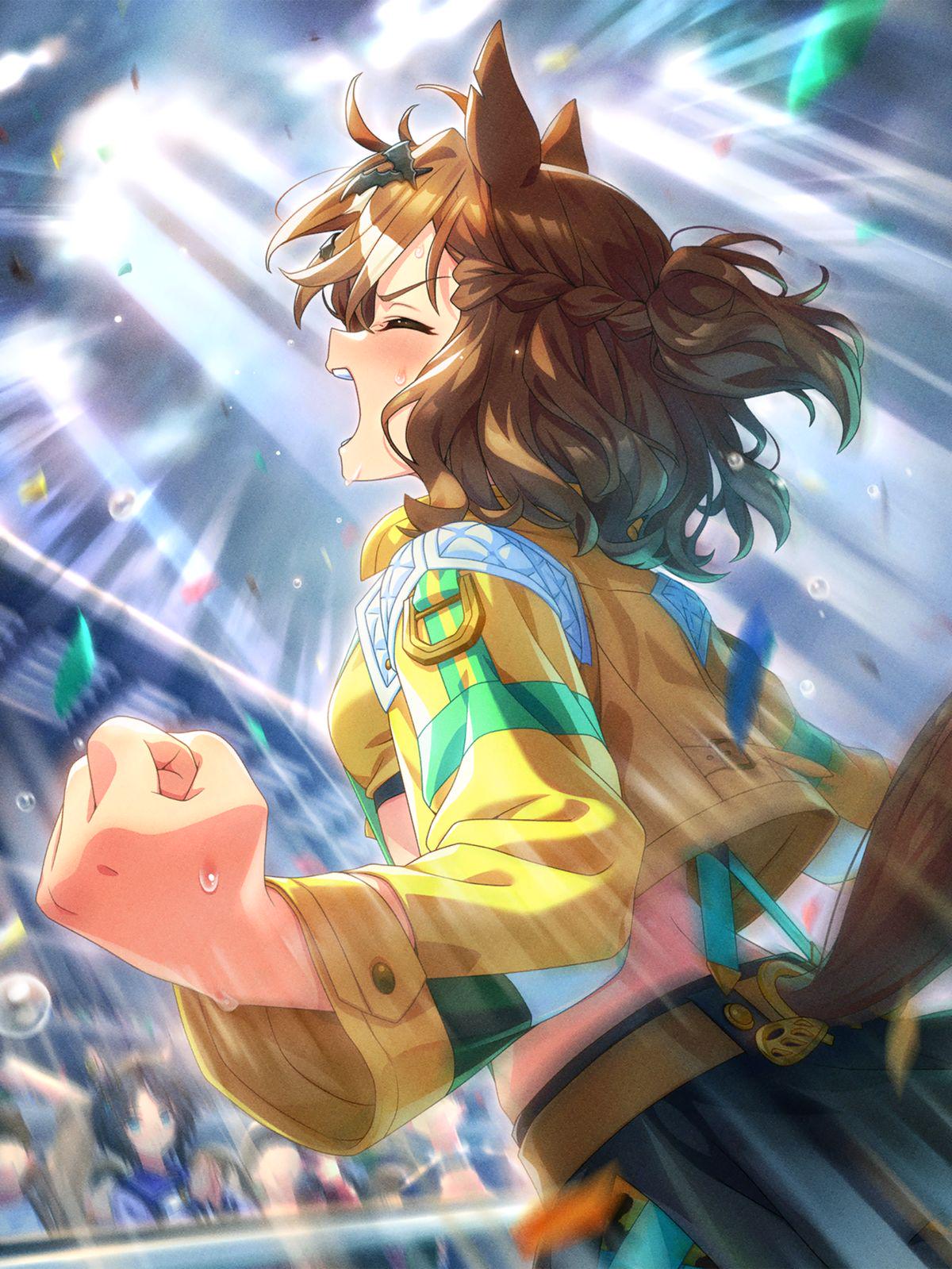
Her bros still turn up to cheer. And when she wins a G1, she doesn’t smile politely and wave. She roars.
走路へ · Out To The Track
Read the outfit. Yellow and white cropped jacket taking its colors straight from her ear cuff; light-green flashes on the sleeves; a black crop top with a yellow bowtie dead centre. Navy skirt, lime suspenders clipped to the belt, and a length of leopard-print fur hanging off the left hip. Then the tell: the right sock slouches, the left is pulled tight. Nothing about it is regulation, and the steel-toe boots with leopard heel panels are the point.
Trainee outfits: Ruler’s Battle Cry (3★, original) and Vermillion Head (3★, cheerleader).
She was also the game’s first semi-limited trainee: permanently in the pool, but never claimable with a paid 3★ ticket. Gentildonna, Orfevre, Still in Love, Cinderella Gray Oguri Cap and Stay Gold followed her into that bracket.
Official artist page: ジャングルポケット (CV. 藤本侑里)
Every row opens Spotify in a new tab. Play goes straight to the track; Find opens a search, for the few not listed under her artist credit.
The franchise’s first theatrical film opened in Japan on 24 May 2024, and it handed the lead to Jungle Pocket.
It is, in the most literal sense, her story: the delinquent who watched Fuji Kiseki run and enrolled at Tracen; the Classic season shaped by Agnes Tachyon and Dantsu Flame; the roar. She carries it as co-protagonist alongside Narita Top Road: her roommate, and the lead of Road to the Top, which shares the same continuity.
She’s voiced by Yuri Fujimoto, and sings Saikyo ROARING (“strongest roaring”) as her solo.
A bay colt with a narrow white blaze, sixteen hands high, bred at Northern Farm in Hokkaido and named, of all things, after an episode of the NHK children’s programme Okaasan to Issho.
He was by Tony Bin, the Irish-bred stayer who won the 1988 Prix de l’Arc de Triomphe before heading to Japan to become one of the most influential imported sires of his generation. His dam, Dance Charmer, never raced a day in her life.
He carried the colors of Yomoji Saito and was trained throughout by Sakae Watanabe, the same owner, trainer and jockey behind Fuji Kiseki, the brilliant colt whose Classic campaign injury cut short. Jungle Pocket would go on to win the Derby that Fuji Kiseki never got to contest.
Thirteen starts. Five wins. Two of them the biggest races in the country, seven months apart, at three years old.

Agnes Tachyon, the colt who had beaten him twice, was gone, a career-ending injury ruling him out of the Classic he was favourite for. What remained was still a proper field: Dantsu Flame and the American-bred Kurofune.
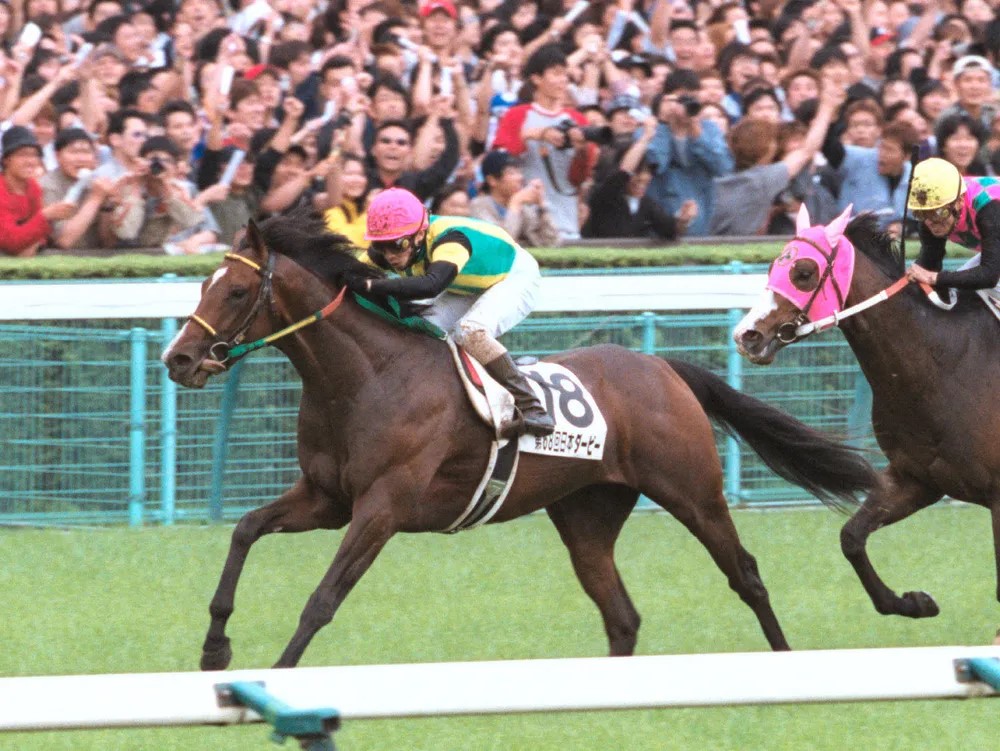
Jungle Pocket drew the outermost gate of eighteen and went off the 2.3 favourite anyway. Koichi Tsunoda brought him through the soft ground to win by a length and a half. Then he did the thing that would define him: pulling up after the line, he threw his head and let out a neighing fit so loud and so sustained it became part of the record. The roar Cygames would later hand to his Umamusume counterpart, note for note.

Fifteen runners, 115,196 people, and a genuinely international field: America, Britain, Germany and Hong Kong all represented, with Meisho Doto, Stay Gold and Narita Top Road heading the home defence.
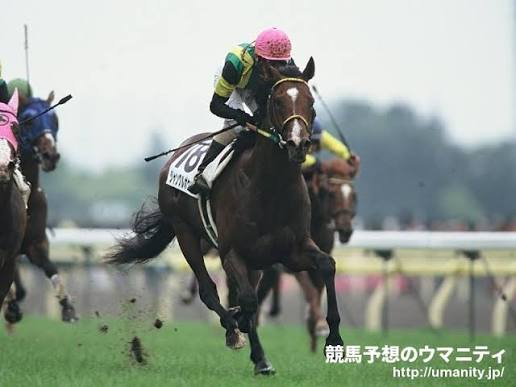
At the top of the market stood T. M. Opera O: seven G1s already banked, six of them consecutive across an unbeaten 2000 season. Jungle Pocket, with Olivier Peslier up for the first time, was second favourite at 4.2. Peslier settled him near the back, swung wide in the straight, and ran the champion down in the final strides, by a neck. The Opera O dynasty ended right there.

Every G1 she wins, she screams the grandstand down. It looks like character design. It isn’t. It’s documentary. The real Jungle Pocket did exactly this after the 2001 Derby, and somebody at Cygames loved him enough to keep it.
A generation is defined by who else was in it. Jungle Pocket’s was ferociously good, and every relationship the Umamusume writers gave her is anchored to a real result on a real afternoon.
Beat him twice and was never beaten by him, then broke down before the Derby and never raced again. The one score that could never be settled.
They met only in the three Classics of 2001. Nowhere else, ever. Jungle Pocket took the one that mattered most.
The stayer he could not get past. Beaten a neck over 3,200 m at Kyoto in what was, statistically, his best run of 2002.
They met exactly once, and Jungle Pocket ended the dynasty by a neck. One meeting, one result, one era closed.
Contemporaries, both tracing back to Northern Dancer and, in the Umamusume telling, the girl she shares a room with.
She admires him more than she’ll admit out loud. In real life they shared an owner, a trainer and a jockey, and Jungle Pocket won the Derby that Fuji Kiseki’s injury stole from him. The debt gets paid on the track.
Her father. Arc winner in 1988, then the sire of Air Groove, North Flight and Sakura Chitose O. The pair share more than a pedigree page: both of them stick their tongues out.
A classmate at Tracen. In the real world, his son: winner of the 2011 Tenno Sho (Autumn) and the stallion who carried the line forward.
Bay stallion, foaled 7 May 1998 at Northern Farm. Thoroughbred family 11-g. An Arc winner on top, Northern Dancer underneath.